Before or after the dinner
Gran Vía and Plaza de España at night
A short guide to two Madrid landmarks that fit around a dinner: the Gran Vía, Plaza de España and the Cervantes monument, with what Wikipedia says about each.
Reserve your table for the evening ↗Quick answer
Plaza de España closes the Gran Vía at its western end, and the Cervantes monument stands in the middle of the square. Both are good for a walk before or after a three-hour dinner. The restaurant is in the Moncloa-Aravaca district, whose neighbourhood Argüelles borders the square, so check the walking time on a map before you plan the evening.
Plaza de España
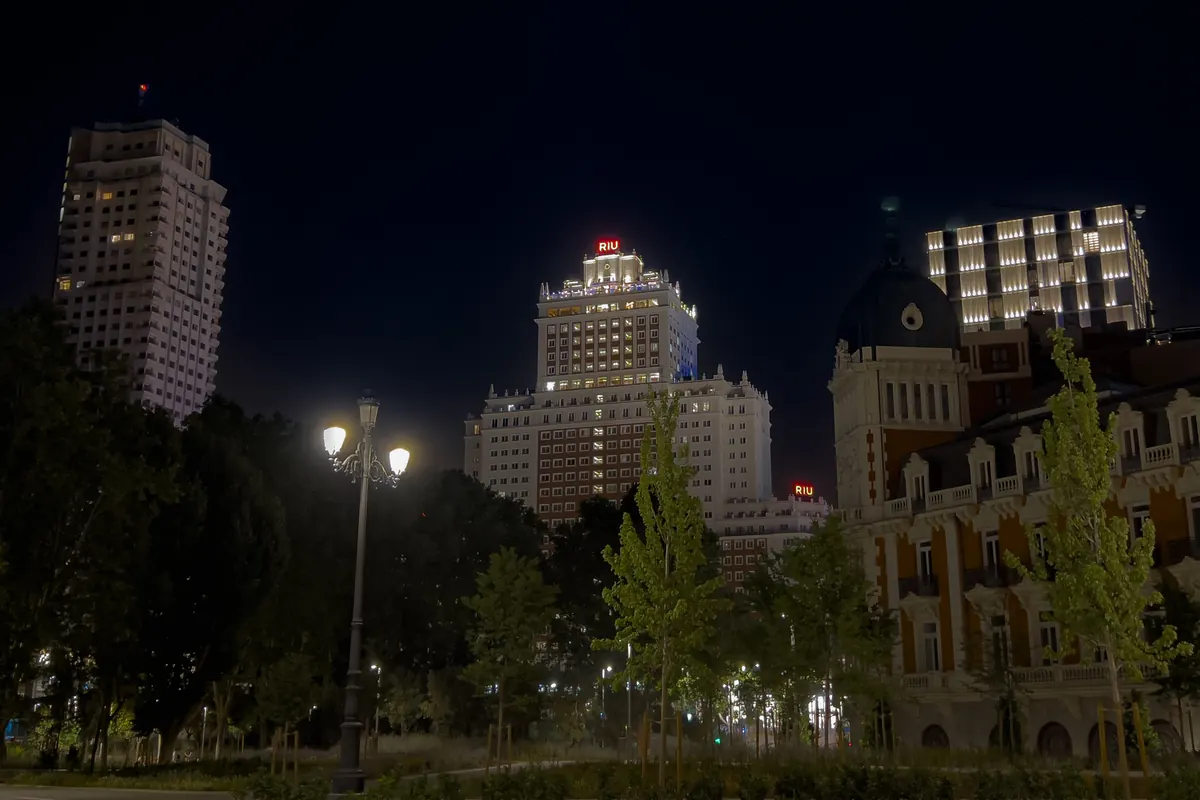
Wikipedia describes the square as a large, popular tourist destination in central Madrid, where the Gran Vía ends. After about two and a half years of renovation it reopened to pedestrians on 22 November 2021. Its centre holds the monument to Miguel de Cervantes, and a rectangular pond in front of the statues of Don Quixote and Sancho Panza forms one of the best-known views of the Spanish capital.
The Cervantes monument
The monument was created at the same time as the square, and its sculpture is made of red stone from Sepúlveda. A seated Cervantes sits above the statues of Don Quixote and Sancho Panza, with Dulcinea and Aldonza Lorenzo added later. Olive trees dominate the landscaping, in tribute to the La Mancha fields of the novel. It is a quiet place to stand for a few minutes after the noise of a dinner. The statues are the point: Cervantes above, and his two best-known creations below him, looking out over the pond.
The Gran Vía
The Gran Vía runs from Calle de Alcalá, close to Plaza de Cibeles, to Plaza de España. Wikipedia calls it the Spanish Broadway and a showcase of early twentieth-century revival architecture. The project was approved in 1904, construction started in 1910 and the last part was completed in 1929. It is one of the city's main shopping streets, with many hotels.
A zarzuela about a street
The street also gave its name to one of the best-loved zarzuelas. La Gran Vía, from 1886, is a género chico masterpiece that was staged in Vienna, Paris and London. Walking the real street after a dinner of zarzuela songs closes a loop: the music is older than the avenue it celebrates. The zarzuela's numbers were dances of its day, a polka and a waltz among them, so the street's later glamour belongs to a different era from the songs you have just heard.
Read next: Six zarzuelas to know before dinner
Temple of Debod
An Egyptian temple stands in Madrid's Parque del Oeste, near the Royal Palace. It was built in the early second century BC in Nubia, donated by Egypt to Spain in 1968 and rebuilt in Madrid between 1970 and 1972. Wikipedia says it is one of the few works of ancient Egyptian architecture that can be seen outside Egypt, and the only one of its kind in Spain.
The buildings around the square
Wikipedia notes two of Madrid's tallest buildings beside the plaza, the Torre de Madrid and the Edificio España, and the House of Gallardo, an Art Nouveau building it calls a notable example of the style in the city. It places the Royal Palace just south of the square. Look up opening arrangements for any building you want to enter before you go.
Who this isn't for
If the dinner is your only evening in Madrid, you may prefer to stay at the table until the toast. If you are tired after three hours, skip the walk. And do not plan around the opening times of any monument without checking them yourself, because this page does not give any.
Frequently asked questions
Where does the Gran Vía begin and end?
It runs from Calle de Alcalá, close to Plaza de Cibeles, to Plaza de España. Wikipedia calls it the Spanish Broadway.
Is Plaza de España close to La Castafiore?
The restaurant is in the Moncloa-Aravaca district, whose Argüelles neighbourhood borders the square. Check the walking time in a maps app.
What is in the middle of Plaza de España?
A monument to Miguel de Cervantes, with a pond in front of the statues of Don Quixote and Sancho Panza. Olive trees dominate the landscaping around it.
Sources